Showing posts with label writing advice. Show all posts

Tuesday, January 11, 2022

Pushing Through Misery


A lot has changed in 18 months. And I find myself coming back to blogging.

The pandemic was slowing down here in the states. The lowest amount of cases in June of 2021 was a remarkable 5,000 for the entire country. Now we have had 1.35 Million cases just yesterday. The Beta Variant is gone. The Delta Variant is dwindling. It seems that the majority of cases of Omicron are less severe and come with an antibody response.

Many of my fellow narrator friends, family members, and old friends have lost a loved one due to Covid19 or Cancer or another illness.

My own father passed away from Cancer. A form called Gastrointestinal Stromal Tumors (GIST) on September 25th of 2021. (For more information on this rare disease, click here.)

We've lost heroes young and old. Quite recently we lost Betty White, Sidney Poitier and Bob Saget.

Here in Michigan, January has replaced December as an unforgiving month of bitter cold with temperatures in the single digits at night.

And while a lot has changed, you have to wonder: How does one power through trauma and misery in order to write another story?

Well, this blog is called Tales and Troubled Times of a Hungry Writer for a reason. 

I am no stranger to Trauma.

Writing has always been therapeutic for me. My mother and father always encouraged my voracious appetite for reading and when I finally started penning my own stories, they gave me tremendous support. When I decided to self-publish my first book, they provided me with money to do so. They kept copies of my books in their bedroom on a nightstand within reach. Every time I told them I had another idea cooking they were both impressed and astonished by my productivity. But they were the ones who fed the fire that continues to burn within me.

Yes, it is easy to get bogged down. To have downtimes. To not even want to glance at a blank page. To regard storytelling as a fool's gambit when you are in the throes of great depression. But the blank page is always waiting. It remains neutral. The blank pages listen to your woes and tries to help you figure them out one sentence at a time.

And while the world seems to be changing rapidly, through peaks and valleys, sometimes grim and sometimes hopeful, I remain convinced and encouraged that better days are just ahead.

At least, that would be my father's outlook. He was always a man with infectious optimism. And I'd like to carry on that tradition.

The last gift I gave my father was a gold pocket watch. These days I find myself wishing we had more time together.

The last gift he and my mother gave me was a FreeWrite Traveler.

Even with all the bad news and daily struggle of sadness, I have found time to finish some stories.

I recently finished what I called THE BIG SCI-FI BOOK, which has been long-gestating. It finally has a cover and is available on Kindle, Nook, and Kobo now. I call it Skyways Of Tomorrow. I am currently halfway through recording the audiobook.


I have also finished a thriller Novella on the FreeWrite.

A story I am 90 percent finished with is a Christmas Novella that will hopefully be out soon. Maybe in February.

And, quite recently, I've decided to end every future story I publish with the words:

In Loving Memory Of
Carmelo Scarlato

Life moves. Friendships are rekindled. Stories are still told.

Our strength as humans is not just in our multiple ways of expressing ourselves but also in that much-needed yearn to express our grief and to be vulnerable. This helps us untangle the wires in our minds. It helps us relate to one another. But it is a feature that is distinctly human.

So continue to write. Write about Sorrow. Write about Joys and Triumphs. Write about whatever your heart desires. Pour out your humanity on the page and it will heal you in turn.

Then you will find that you're not just pushing through misery. You are creating something new and beautiful which will make your loved ones proud.

I'm still writing stories, Papa. These yarns are for you.


Saturday, May 7, 2016

My Writing Method


I've been writing for a long time. But I don't think I've ever described my method.

In an effort to be totally transparent, I'd like to share mine. Maybe you've come to this blog to find out who I am. Maybe you're an aspiring writer yourself and don't know how to get started. Maybe you've started a book and are stuck and are looking for an inspirational push in the right direction. Whatever the case may be, I hope this gives you a peek at my process and maybe figure out your own. Just so you know, the process can always change, and in my case it often does. It evolves. And you would be better served to know that now rather then later. So, here we go.


1. The Seed

Well, it starts with an idea. Something that gets planted in my brain that I can't dislodge. If it's completely unshakable, let's say for three to four weeks, then I seriously consider putting the idea on paper. The idea can either start from a line of dialogue, a piece of description, a unique character, or just one well-crafted scene. It also can arrive in my dreams. Sometimes they are garbled, on the fritz and I have to do some deciphering. Other times it can be very vivid and I remember everything. Wherever the idea comes from, once its planted, I am committed to caring and pruning that story tree.


2. The Title

Before, I used to not fret over title. But now I do. I like to think of the title before I even start writing. It can serve as a good placeholder should I decide to change it later. It's best to keep it short, snappy and memorable. It's an effort to describe the story, or at least one aspect of it, in one to eight words. This is still moldable, but I try not to bounce around too much with it.


3. Outlining

I used to do extensive outlines. With my first book I'd spend a paragraph describing what needs to happen in each chapter. Each chapter, I thought, needs at least one conflict to overcome. But then I realized this doesn't give the reader time to breath. My first outline was 15 pages.

Then I started doing one sentence descriptions. While this may be a good start for some, for me it just bogs down the process. Then, I later find out that I've only used 20% of the outline in the actual story. And that made me feel like a story was too scripted. 

Here's an example I pulled from Pickpocket Frankie. This outline was written years ago and I have strayed heavily from it.


4. Let The Characters Talk

Here's something they don't tell you about writing. You have to disappear. What I mean by that is you have to write something that doesn't feel like it was written by you. Whenever I tackle a project, I try to remain as a causal observer. The characters often lead me to surprising revelations or unexpected twists and turns. The more I let them play, the more they are controlling the story. The more they tell me things.


5. Layout

When I first started writing, I'd focus on one single page. And that produced a lot of headaches and anxiety. There's nothing more intimidating than that little blinking cursor. Eventually, I found out that focusing on one page at a time was too claustrophobic. I needed a full perspective. So, I decided to zoom out. With this layout, I can see what I wrote before and what comes after. Again, here's an example of my writing view with Pickpocket Frankie.


6. How I Type

I use two fingers. Both my index fingers. Yes, yes, I know it's not proper writing etiquette but I don't care. This is the fastest way I can type and a way to get all my thoughts onto that page. Even with writing blog posts, I write with two fingers. It's my preferred method and I'm sticking to it.


7. Silence isn't Golden


When I first started my very first book, I wrote in complete silence from the hours of 11pm till 3am. It was a hellish work schedule, especially when I needed to be up in time for school, but these were the best hours at the time. Later on, when I started taking on short stories, I realized that silence was slowing down my progress. My characters are no longer happy with the stoic, concentrating silence of yesteryear. Now they have a rhythm. Depending on the mood of the scene, or the story itself, my characters often choose a soundtrack for their actions. And, depending on the music, the words really seem to take off. Now, I don't know which is your preferred method, but I would suggest that if you can see the story like a movie in your head, why not have a score for it?


8. Word count


I think of the word count as a budget. Before, I didn't worry about it. But now I do. I researched genres. Fantasy books are usually around 100,000 words. Thrillers: 70,000 - 80,000. Crime Fiction:50,000 - 60,000. It's okay to go a little over but I constantly want to be concise.


9. Editing and Revising


I usually rewrite and revise as I go along. I'll write two chapters. Give it a few days to cool off, then come back to it and re-read the scene. If a sentence is clunky or doesn't serve a purpose or can be re-worded in any way, then I cut and revise. I heard that Dean Koontz rewrites his books in a strange way. He revises a page of work 40 times until it is perfect. Then he moves on to the next page. And if this is a 300 page book. That's a total of 12,000 revisions. Yikes. I don't think you have to go that far. Just try to do the story justice.


10. Read it Out Loud

A story will not make sense unless you read it out loud. We all have an internal reading voice and sometimes that voice can be misleading. Sometimes it will substitute through with threw or there and their or then and than. You get the idea. The best form of revising is reading it out loud. You can even perform it like an audio book to yourself.


11. Audience

In this profession you can't just write something and expect to know how to present it. You need to know your audience. I write for an audience of one. I write with my wife in mind. She's a reader as well and has read a good majority of my work. In the scenes I try to make her laugh, gasp or even keep her on the edge of her seat. And when I read her my work out loud, it can be a real big boost to see her reacting to the story. Whoever your audience is, find a person you can trust who likes to be read to and ask them to be your own personal story observer. Ask them what they like. What they didn't like. If a sentence made sense. If a character seems too thin. It will have huge benefits in the future. Besides, your audience member might be thankful and curious to see what you're working on next. Just make sure you are writing in a genre they enjoy.


12. Mindwriting

As I've said before, I used to write outlines. But now I just write in my head first before I start physically writing. I think of the project like a movie, one where I get to watch the dailies and figure out what I like and what can be cut. After I've seen the whole thing in my head, the scenes write faster than anything before and my keyboard is smoking with friction burn.


13. Preferred Tool


I've tried pens and pencils. I've tried desktop computers. Now I only write on laptops. They're compact, lightweight and are, I'm convinced, the only thing I will ever write on.


14. Where to write


Some writers retire to a room. Something that they've set up to be the perfect shop for inspiration to strike. I've heard of two authors, Wally Lamb and Chuck Wendig, who have actually built their own private Writing Cabin or Shed. Now, unless you've got the money and time to shell out to make this dream come true, there's a universal truth you need to admit: There will never be a perfect place or a perfect time for your writing. Jack Kerouac wrote on one long scroll, Jame's Joyce wrote in a white suit, Mark Twain wrote in bed, Ernest Hemingway would write while standing up on a typewriter that would sit on his dresser.

I wrote Village Americana at Starbucks. I wrote Ye Olde Idea Shoppe in the living room of my very first apartment. I wrote my first short story in an attic. It doesn't matter the place or the time. What matters is that you actually write the damn thing.


15. How to End a Story

Believe it or not, this one still eludes me. Sometimes it just hits me. Other times I have to dig. And digging takes time. And it takes commitment. If you're willing to get your hands dirty and not let your story stagnate, I suggest you pick up that metaphorical shovel and pry it out of that deep dark hole.


16. Always leave room


Hemingway once wrote that he would never write to completion. He'd always leave, what he called, a little bit left in his story well. Enough to write something for tomorrow. My normal writing session was 500 words at a times. Now I can pound out one or two chapters if I have a good writing flow.  


17. Notes, notes, notes

When I feel like I have a really good idea but need more time on it. I keep all my notes in one file, which I call my Jumble Box. There's really no rhyme or reason to it. I just write down the title, form and something short to describe it. 


That's pretty much my entire writing process. Hope it works for you. It has for me...so far.

Until next time, keep writing.


;)


Saturday, February 15, 2014

Writing With Cinematic Style Part I


Before I was a writer, I was a filmmaker. But the problems that I faced were always budget. Granted, with a reasonable budget, you can make a decent film. And that's if you have that cinematic eye. Which, sadly, not many people have but continue to make films. 

So when I stashed all my ideas in a box, I let them sit.

Then I got the idea of adapting one of them into a short story.

Then I began on a novel.

Now, whenever I adapt one of my ideas into a book, I feel like I am working with unlimited sets and billions of dollars in budget.

So for this series, I figured on showing you how you can take your film-making skills and adapt them to novel writing.

Let's start with the first chapter.

Think of the first chapter as your first scene or a cold open. This is your first impression. Your first chance to win the audience. You have to hook em. In order to hook em you have to toy around with thier emotions, make the scene visceral and cause an emotion. Because if the audience feels nothing, why would they continue with the rest? Your 1st chapter or prologue is what comes before the title credits. And in that short amount of time you have to establish the following:

SETTING, TIME PERIOD, CHARACTERS, GENRE, THEME, CONFLICT, HISTORY, RELATIONSHIPS, MOOD, DIALOGUE, NARRATIVE VOICE, PACING, IMAGERY, DIRECTION, STRUCTURE, SURPRISES, ETC.

It's a lot to set up in a short amount of time, but if you have a clear view of what the story will look like and the direction it will take, then you will succeed in transporting the reader there.

I tend to focus on imagery the most. My wife and my in-laws have told me that I write with a cinematic style and, knowing that, I have a better understanding on not only how to write but how to keep the audience engaged.

Even though writing can be a solitary venture on just using words to tell your story, it is a very visual medium.

So start your first chapter today.

Take us to another world.

The world of your imagination.


Saturday, January 18, 2014

The Following or How I Learned To Stop Worrying and Love The Bomb


In 2008 I was toying around with the idea of writing a short story collection. It began with a handlful of objects. Toothpicks, pennies, paperclips. I tried to weave a story around these items. Some of them were more prominent in the story than others. 

But one story I really enjoyed writing was The Graveyard Shifters, a tale of two misfits who stumbled upon a gothic device that somehow transports the consciousness into a corpse. What's more, it is later revealed that the device belonged to Edgar Allen Poe. Before this story, I didn't know much about him. I read some of his stories but it wasn't until I read a biograpghy of him that the seed of my short story really began to develop.

That was then.

Now I feel like everyone is shoving Poe down my throat.

It's gotten to the point of saturation. I hear the name so much, that I get annoyed when someone wants to educate me on Poe.

It was bad enough that I was burned by watching 2011's The Raven. Granted, I don't fault the actors. They did the best with what they had. I blame the script. They fudged some facts, tied in a serial-killer/Saw angle, dressed up the villian in the same wardrobe of V for Vendetta, with a Sai for a weapon, I might add. And there you have it. Now EVERYONE  and their brother thinks they know what's what with Poe.

At first, my wife and I were excited to see the show seeing as how we hardly heard anything about it. So we were going in with somewhat hopeful expectations.

Good Grief.

You know you're watching a bad movie/tv show when you start rewriting things in your head.


So here are a few scenes that really irked me and made me realize that I was watching a terrible show.


A killer in the show is obssessed with Poe, to the point that he has built a following of people, like Charles Manson. 

1. It's All Been Done Before
So, at the begining we have a setup that could work, had it been excuted with a little originality in place. But instead we get formulaic, predictable story points which aren't even points, really. Joe Carroll, the killer is a literature professor who has had many students who he has mentored and in this instance, he was caught by Kevin Bacon's character, via a whole Hannibal Lecter/ Will Grahm scenerio.

Kevin Bacon is still coping with almost meeting his end by the hands of Joe Carroll. Enough so to the point that he has to hide vodka in his water bottles.


2. Scenes Play Just For Shock Value:
As Bacon and others are brought back on to the case, after Carroll escapes prison, they start calling in all the people who were connected, in some way, to the killer. One woman stands up, strips naked, revealing scribbled text over her body and stabs herself in her own eye. All I have to say, and it should be glaringly obvious, is what does this have to do with anything? It doesn't do anything to move the story forward. It's just creepy for creepy's sake. And, why would the killer be sending her as a message? Wouldn't a post-it do? Or, I dunno, maybe not warning the lead detective at all? Maybe take him by surprise? Then Keven Bacon displays what I call false genius. Somehow, he's the only one who can tell, at a glance, that all the writing on her body is by Poe. Big whoop.


3. We're Still Doing The Whole Writing In Blood On The Wall Thing?:
At one point, in a garage, the killer has written NEVERMORE in the victim's blood. Um...okay? So...what does this have to say about ANYTHING? Does this mean that the killer will nevermore murder again? Is he alluding that death is a raven that taunts you? No, it's just creepy being creepy for creepy's sake. Hey, I've been guilty of this little trope myself but I've learned from my bad writing in order to identify what bad writing looks like. And this is bad writing.


4. If You Are Going To Use Poe, Use His Other Stories:
Over the course of the first episode, Poe and a handful of his literary works are mentioned. The Tell-Tale Heart and The Raven. Why not use something else, huh? Like, I dunno, The Cask of Amontillado? There's a story that could be portrayed, a person being bricked in somwhere. Or Fall of The House of Usher? Or Muders at The Rue Morgue? Use anything else! Because when you only use The Raven and The Tell-tale heart, that, as a viewer, tells me that you are only using what you believe to be his greatsest hits.


5. It's Not A Plot Device, It's Just Plain Lazy:
By the end of the episode, we learn that several people, we thought we could trust, are actually underlings working for Joe Carroll. At this point, in my mind, someone should be tossing papers in the air and rolling their eyes. By this rational, anybody could be a hidden discple of Joe Carroll. Which you would think is an edgy plot device but really it's just plain lazy. Every episode could have somebody who is conveintally working for Joe Carroll. It just really spoils the show.

Anyway, I guess I'm done ranting about the show but, if anything, I've taken away a valuable lesson from this. Sometimes you have to hunker down and watch a terrible show or movie. Even if its just for a minute. Why? Becuase each story is a lesson on writing. Either you learn how not to make the same mistakes as others or you can find a different path to a story, completely wowing your intended audience in the process. After all, that's what writing is all about, isn't it? Just a constant chain of people observing what worked and what didn't and trying their hand at it. So pop in that movie with the chicken-scratch script. Because even if it is a bomb, it will teach you a valubale lesson in creativity and how to control it.

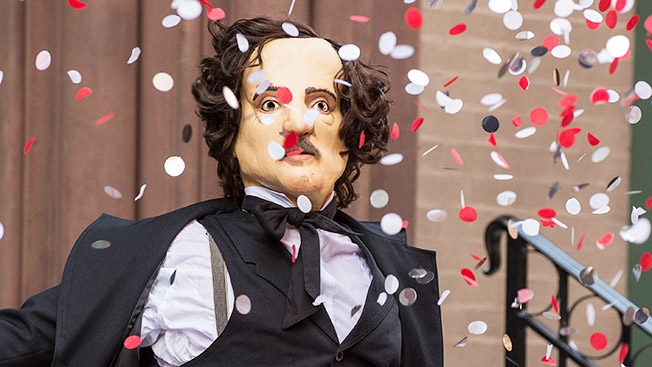
Needless to say, I won't be watching the rest of this show. Too afraid of wasting my time with it. I've already gleaned as much as I could from the first episode. I guess it couldn't be all bad. I mean, hey, at least they aren't using the stereotype of someone dressing up in Edgar Allen Poe attarie with a bobble-head paper mache face. Man, it'd be even worse if they had him throw confetti like Rip Taylor or something, right?


Oh for Pete's sake.